Engineered, Built, Healed: The Real Immigrant Workforce
If you need a house built, a pipe fixed, or a bone set in London today, statistics suggest you are increasingly looking for an immigrant.
For years, the conversation about immigration in London and Middlesex has focused on "filling gaps." We talk about labour shortages as if immigrants are simply plugging holes in a leaking boat. But new data from the London & Middlesex Local Immigration Partnership (LMLIP) suggests we need to retire that metaphor.
Matter of Facts #48 reveals that immigrants aren't just supporting our economy; they are actively engineering, building, and healing it.
As the city grapples with anxiety about housing supply, healthcare wait times, and infrastructure capacity, the data offers a stabilizing reality check: the people arriving are disproportionately the ones qualified to fix the very systems we fear are breaking.
More Than Just Moving Goods
There is a pervasive myth that immigrants are primarily driving our delivery trucks or staffing our checkout counters. While those are essential roles, the data tells a much more muscular story about London’s physical infrastructure.
Source: Statistics Canada. Community Data Program, Table EO3775 – Ontario 3 – 2021 Target Group Profile cross-tabulated with Immigration Status by Period of Immigration and Citizenship
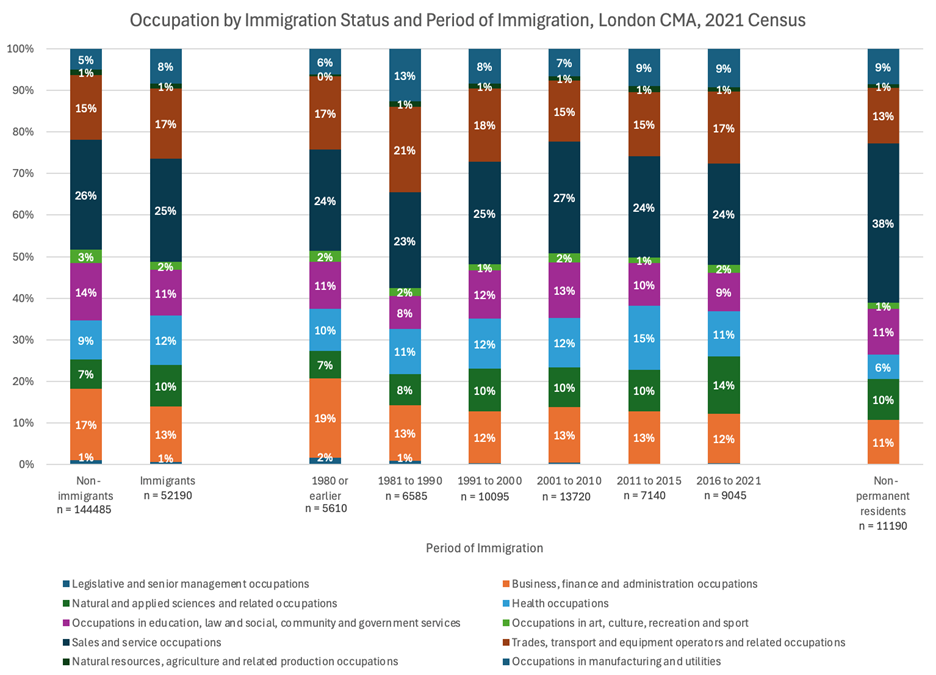
According to the 2021 Census data highlighted in the fact sheet, immigrants in the London CMA are actually more likely to work in trades and transport (17%) than the Canadian-born population (15%).
Let that sink in. In a country desperate to build 1.5 million homes province-wide, the immigrant workforce is statistically heavier on the "builders" than the local population.
While national data suggests a split between construction trades and logistics, reflecting London’s dual identity as a building boomtown and a logistics hub along the 401 corridor, the implication is clear. Whether they are framing the houses or moving the materials to the job site, London’s physical growth is being shouldered by newcomers.
The Changing Face of Care
Perhaps nowhere is the immigrant contribution more critical, and more personal, than in healthcare.
The fact sheet shows that 12% of all employed immigrants in London work in health occupations, compared to just 9% of non-immigrants.
This is about the entire ecosystem of care. From the Personal Support Workers (PSWs) in our long-term care homes to the nurses in our ERs, the "face" of care in London is changing.
When we talk about "healthcare capacity," we are often talking about human capacity. This data confirms that immigrants are the reinforcements keeping our hospitals and clinics standing. They are the 12% dedicated to healing the rest of us.
The "Engineered" Reality: A 100% Increase in Innovation
The most striking trend in the new data is the evolution of the "Science Immigrant."
For immigrants who arrived before 1980, only 7% worked in natural and applied sciences. For those arriving between 2016 and 2021, that number has doubled to 14%.
This isn't an accident. It perfectly tracks with London’s post-2016 boom in tech, advanced manufacturing, and health innovation. As our region pivots toward agri-food tech, digital media, and medical research, the immigrant workforce is pivoting with it—faster, in fact, than the general population.
These are engineers, software developers, and researchers. They are the architects of London’s future economy, driving the innovation that keeps the region competitive globally.
The Challenge: The "Waiting Room" of Potential
Source: Statistics Canada. Community Data Program, Table EO3775 – Ontario 3 – 2021 Target Group Profile cross-tabulated with Immigration Status by Period of Immigration and Citizenship.
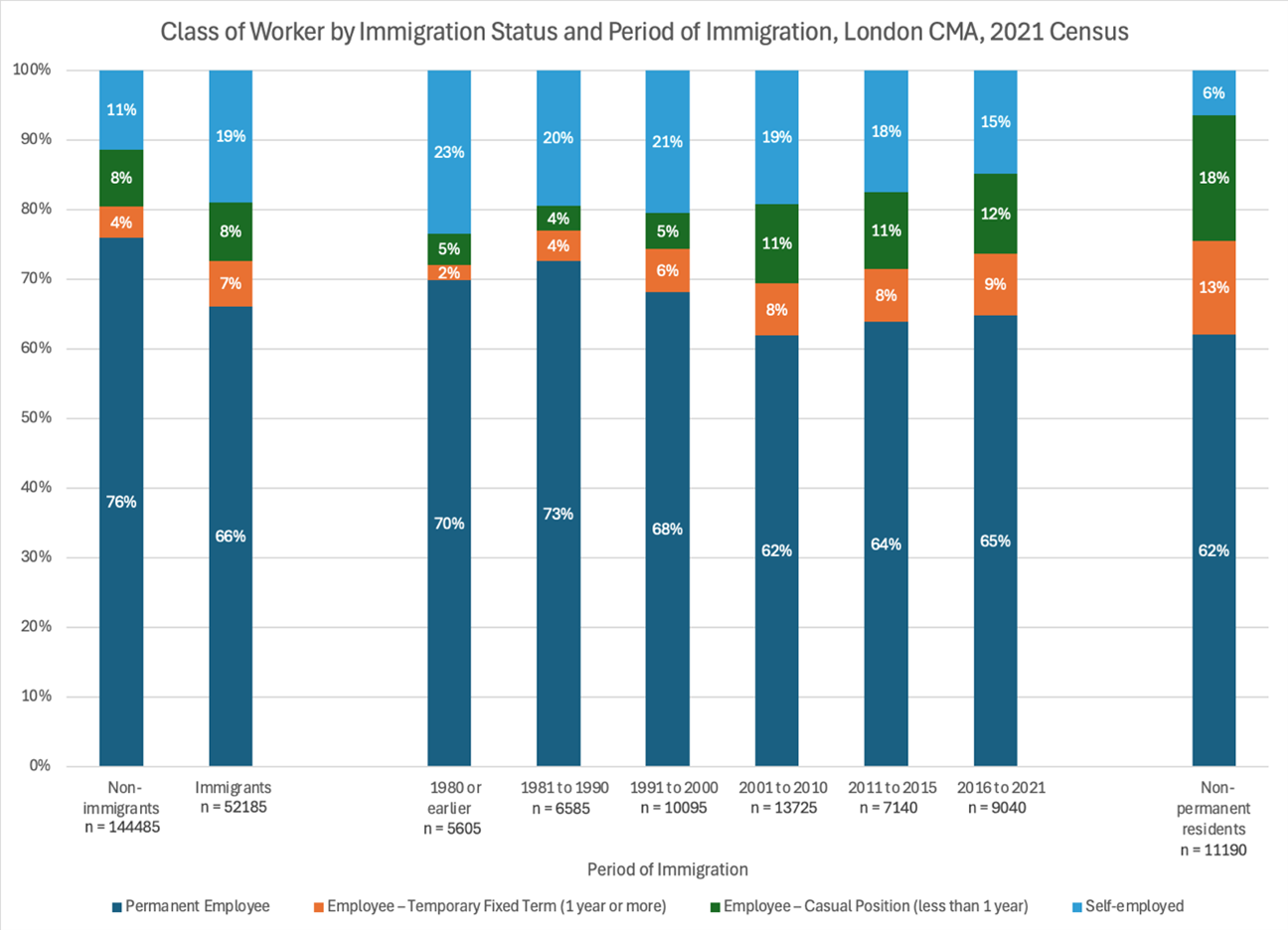
However, the data also reveals a tension we cannot ignore. While the newest arrivals (2016–2021) are the most likely to be in STEM (14%), they are also the most likely to be working in sales and service occupations (24%) and hold the highest rates of casual (12%) and temporary (9%) employment.
This is the "Waiting Room."
We have a cohort of highly educated, motivated newcomers who are currently underemployed, likely working in survival jobs while they navigate credential recognition or look for that first "Canadian experience" break.
This represents massive "potential energy" for London. These are the engineers working retail; the nurses working as aides. If we can solve the credential recognition bottleneck and open pathways for these permanent residents, we unlock a massive reserve of talent that is already here, already housed, and ready to work.
The Takeaway
The data in Matter of Facts #48 shifts the burden of proof. It is no longer about whether immigrants can "integrate" into our economy. They are already driving its most critical sectors.
The question for London employers, policymakers, and neighbours is: Are we doing enough to keep them?
If immigrants are statistically more likely to be the ones building our homes and healing our sick, then retaining them isn't just a "welcoming" gesture; it’s a survival strategy.
London’s economic future isn’t just being supported by immigrants; it is being engineered, built, and healed by them.
For the full data breakdown, read Matter of Facts Series – Part 48.