Three tenths of a point
Matter of Facts, Part 60. Prepared by the London & Middlesex Local Immigration Partnership Fact Sharing Work Group.
Last year a survey asked 387 permanent residents in London-Middlesex to rate their own lives. Men and women answered differently. Not by much.
On a seven-point scale, men rated their life satisfaction 5.0 and women rated theirs 4.7. Men rated their sense of belonging to London-Middlesex 4.8, women 4.4. For their own neighbourhood, the numbers were 4.8 and 4.3. When asked how hard it was to find a job matching their qualifications, men said 4.1 and women 4.5, with a higher number indicating it was harder.
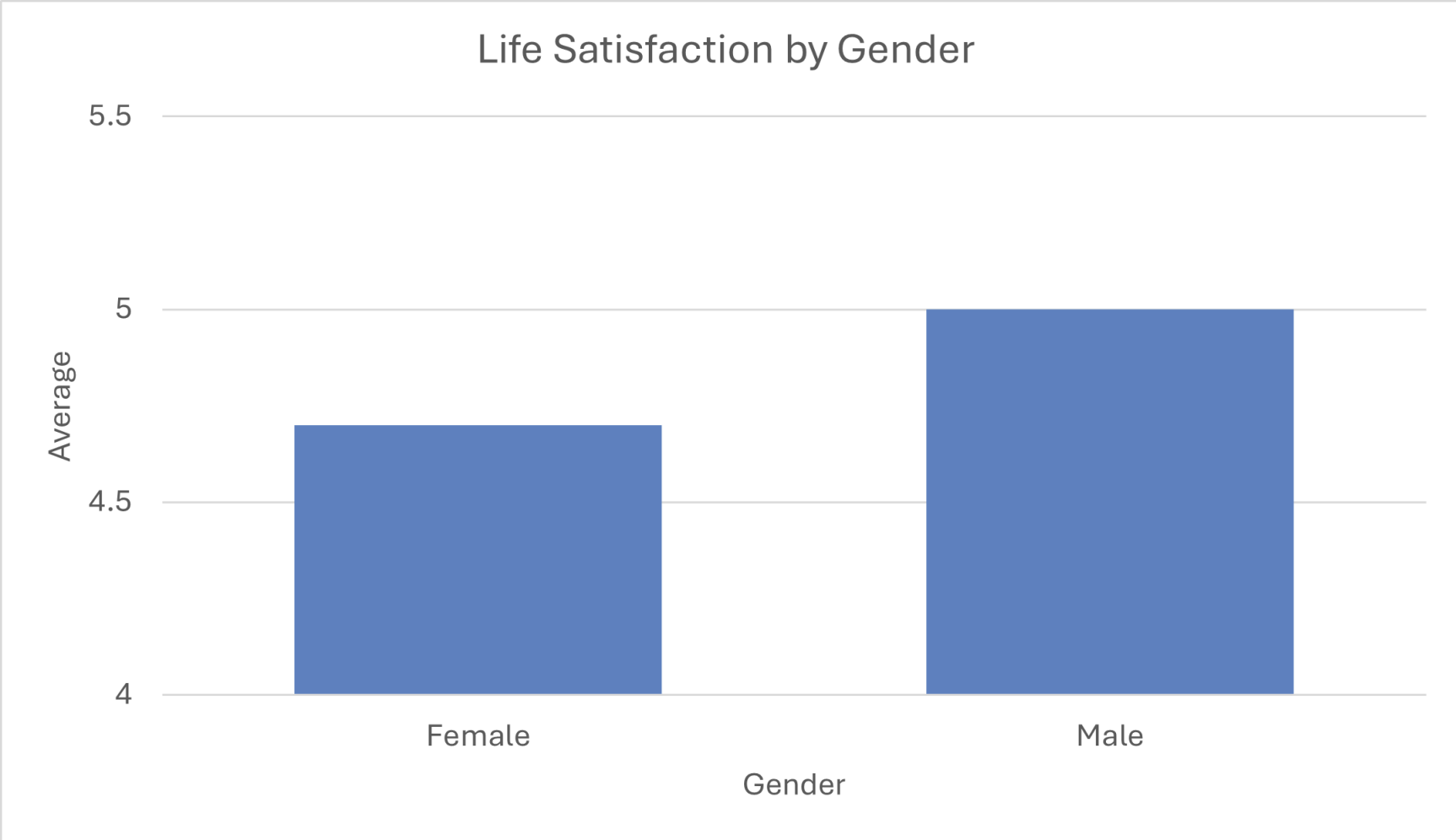
Source: Lammert, J., Oshiogbele, G., Nielsen, E., & Esses, V. (2025). Survey of newcomers to London-Middlesex (Part A): A study of the experiences, challenges, and strengths of permanent residents in London-Middlesex. City of London. Based on the responses of 387 permanent residents. Life satisfaction was reported on a 7-point scale (1 = Not satisfied at all to 7 = Extremely satisfied) and difficulty finding a job in London-Middlesex that makes use of respondents’ qualifications was reported on a 7-point scale (1 = Not at all difficult to 7 = Extremely difficult) for images left to right respectively.
Three-tenths of a point. Half a point at the widest.
If a neighbour rated her life a 4.7 and you rated yours a 5.0, neither of you would think you were living different lives. Nobody redesigns a service over three-tenths of a point.
Then the survey asked the same people about their work.
Two-thirds of the men, 67.5%, were working full-time. Women were more likely to be working part-time (25.7%) and more likely to be unemployed and looking for work (11.8%).
It also asked what kind of work. Jobs can be sorted by the level of schooling they typically require. The lowest category covers work that requires no formal education. Across everyone surveyed, 26.8% held a job in that category. Among the women, it was 37.4%. Men were most likely to hold jobs in the category that typically requires a university degree.
Most of these people are qualified. More than 60% hold a university, graduate or professional degree, and more than 85% earned it outside Canada.
So one survey asked two kinds of questions. When asked how they felt, women answered within half a point of men. When asked what work they had, the answers diverged significantly.
Both sets of answers are honest. A rating scale works like a compass, not a ruler. All four ratings pointed the right way. None of them could show how far.
People also rate their lives against what they expected and against the people they see every day. A woman who arrived braced for a hard few years, living among women in the same position, may fairly call that a 4.7. Nothing in this survey says these women are doing badly.
It says their training is going unused.
The survey cannot say why. It did not ask who looks after children at home. It did not record who applied as the main applicant and who came along as a spouse. Those are the first two explanations most readers will reach for, and this data confirms neither.
What to do with this? If you run a service, do not wait for someone to tell you she is struggling. She may not think she is. Ask her a different question. Does your job use what you trained for? A woman who is content and underemployed will answer that one plainly. A question about satisfaction will never find her.
There is also a clock running. Since 1 April 2026, economic-class permanent residents can use federally funded settlement services for six years after they land. That includes spouses and children who came with the main applicant. On 1 April 2027, the window narrows to five years. Employment and settlement help in London is free for those who qualify.
Six years, and then five. The sooner someone asks her what she trained for, the more of that window is left to use.
Sources: Lammert, J., Oshiogbele, G., Nielsen, E., & Esses, V. (2025), Survey of Newcomers to London-Middlesex (Part A), Network for Economic and Social Trends, Western University, for the City of London and LMLIP; Sections 3, 7.1 and 7.2, and Figures 8, 57, 61 and 86. Based on the responses of 387 permanent residents, except sense of belonging (383 and 382). Immigration, Refugees and Citizenship Canada, notice of 10 March 2026 on settlement service eligibility for economic immigrants.