Who counts as new in Middlesex County
Matter of Facts, Part 59. Prepared by the London & Middlesex Local Immigration Partnership Fact Sharing Work Group.
The last few issues of this series stayed inside London, working through the city one planning district at a time. This one crosses the city limit.
Middlesex County, outside London, has about 78,000 residents. The 2021 census counted 7,510 immigrants among them, meaning people who were born outside Canada and became permanent residents. Most of that group, 6,355 people, have since become Canadian citizens. The other 1,155 have not.
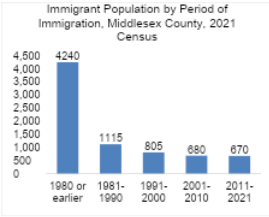
Then look at when they arrived.
Source: Statistics Canada. Community Data Program, EO3775, 2021 Target Group Profiles. Note: Middlesex County Profile was derived from LMLIP and City of London Group Profiles, with rounded numbers from census data.
More than half of them, 4,240 people, arrived in 1980 or earlier. Another 1,115 came during the 1980s. Only 670 arrived across the whole decade from 2011 to 2021.
That trend has a history, and the history is agricultural. Seven in ten of the county's immigrants were born in Europe. After the Second World War, the Netherlands had far more farmers than usable farmland, much of it still underwater from wartime flooding. Canada was looking for people to farm. The two governments ran a resettlement program, and tens of thousands of Dutch farming families came through it to southern Ontario. Belgian and German families arrived in the same years. Some of them landed here.
The census counts a woman who arrived from Rotterdam in 1953 exactly the way it counts a family who arrived from Colombia in 2019. Both are immigrants. Only one of them is new.
Read the county's numbers with that in mind, and one group turns into three.
Roughly 5,400 of these immigrants came before 1991. They raised children here, and plenty of them have grandchildren here. They stopped needing settlement help decades ago. When a report says Middlesex County has 7,510 immigrants, this is most of who that means.
About 670 people arrived in the ten years to 2021. This small group is the one settlement services are actually built for.
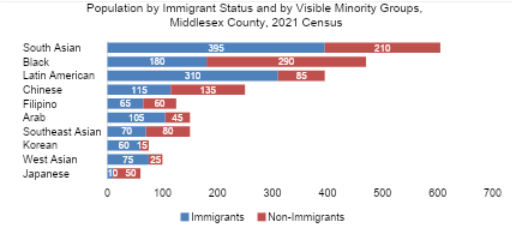
Then there are the people who were born here. The 2021 census counted 2,660 county residents who belong to a racialized group. The four largest were South Asian (605), Black (475), Latin American (400) and Chinese (280). Split those groups by birthplace, and the picture changes community by community. Roughly four in five Latin American residents are immigrants. The pattern reverses for Black residents, with the census counting 290 people born in Canada versus 180 immigrants. Take the ten largest groups together, and roughly four in ten of the people in them were born in Canada.
Source: Statistics Canada. Community Data Program, EO3775, 2021 Target Group Profiles. Middlesex County Profile was derived from LMLIP and City of London Group Profiles. Note: Counts may not sum to totals due to rounding applied to census data.
That last number is the one worth sitting with. Black families have lived in this county since 1829. That year, free Black families from Cincinnati bought land in what is now Lucan Biddulph and built the Wilberforce Settlement. The census cannot trace anyone's family line, so it cannot say who descends from whom. It can be said that the neighbour most likely to be asked where they come from may well have been born a few kilometres away.
About 670 arrivals in a decade works out to roughly 67 people a year, spread across the county's eight municipalities. Sixty-seven is not many. It would be easy to read a number that small as too few to build anything around. Middlesex County read it differently.
Numbers that small and that scattered will not support a settlement office in every town, so the help sits inside places people already go. Middlesex County Library branches are information hubs, and library staff train as Community Connectors who can point residents to the right service. The YMCA of Southwestern Ontario runs a Newcomer Settlement Program with one advisor covering the whole county. It serves refugee claimants, immigrants, and people here on study or work permits.
The widest door is the Community Navigator. Navigators help with housing, work, school, health care, food and paperwork, and they help fill out the applications too. Any Middlesex County resident can use one. There is no referral, no eligibility test and no cost. Call 519-930-1012 or email communitynavigator@middlesex.ca.
Which brings us back to the count. Last year the LMLIP ran a campaign called I Am Middlesex. It celebrates immigrants who have settled well and made the county their home. The 2025 faces were Rishi Deonarine, Hanadi Gad and Mostafa Heikal.
Settled well describes almost everyone in that group of 7,510. Most of them managed it two generations ago, back when the county was a place people came to farm. The 67 who arrive this year should be able to say it too.
The London & Middlesex Local Immigration Partnership is funded by Immigration, Refugees and Citizenship Canada.
Source: Statistics Canada. Community Data Program, EO3775, 2021 Target Group Profiles. The Middlesex County profile was derived from LMLIP and City of London group profiles, and covers the county outside the City of London. Counts are rounded and may not sum to totals.