Matter of Facts, Part 55. Prepared by the London & Middlesex Local Immigration Partnership Fact Sharing Work Group.
London's youngest children are not spread evenly across the city. They live in clusters. The 2021 Census counted children in every planning district, and the picture is clear: the most young children live in a handful of neighbourhoods across west, east and south London.
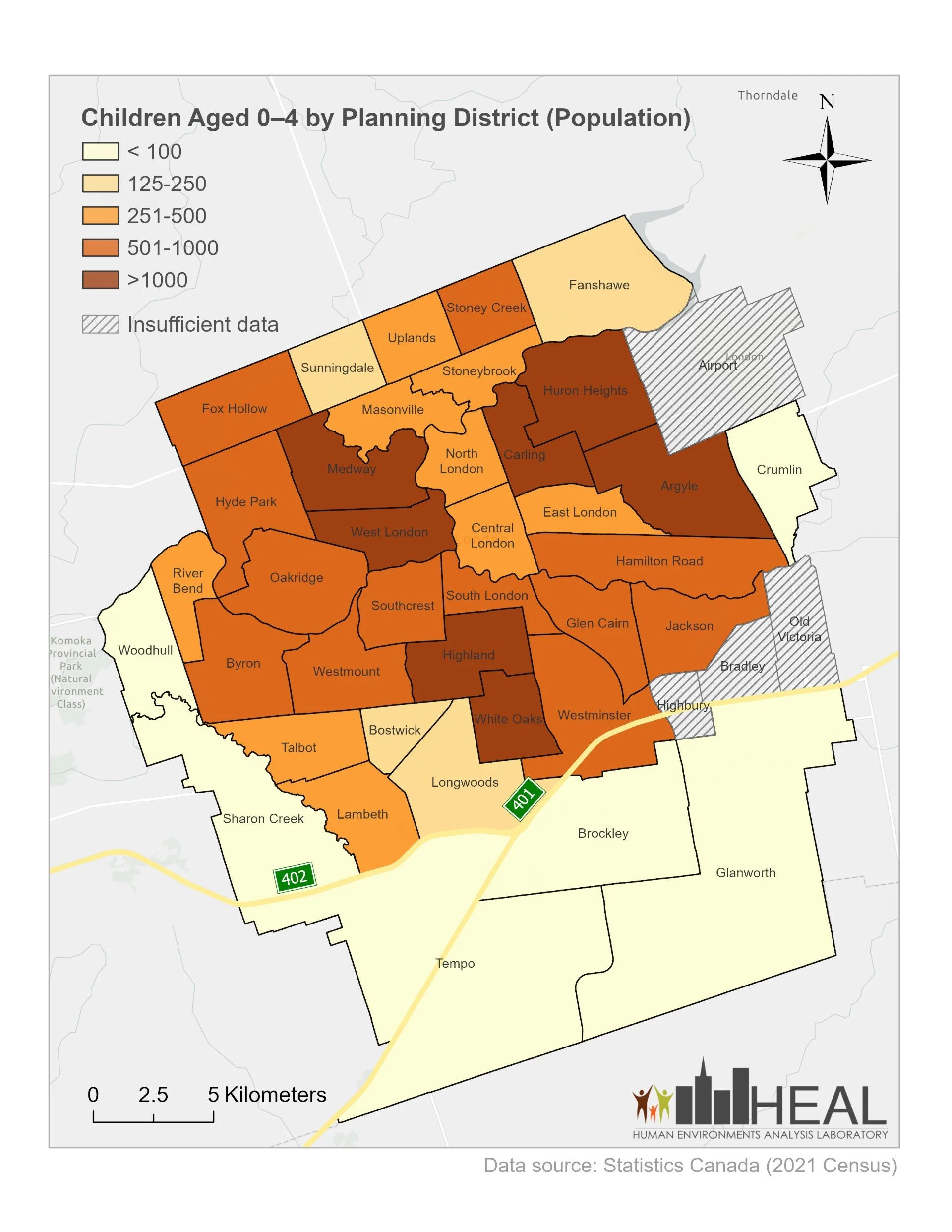
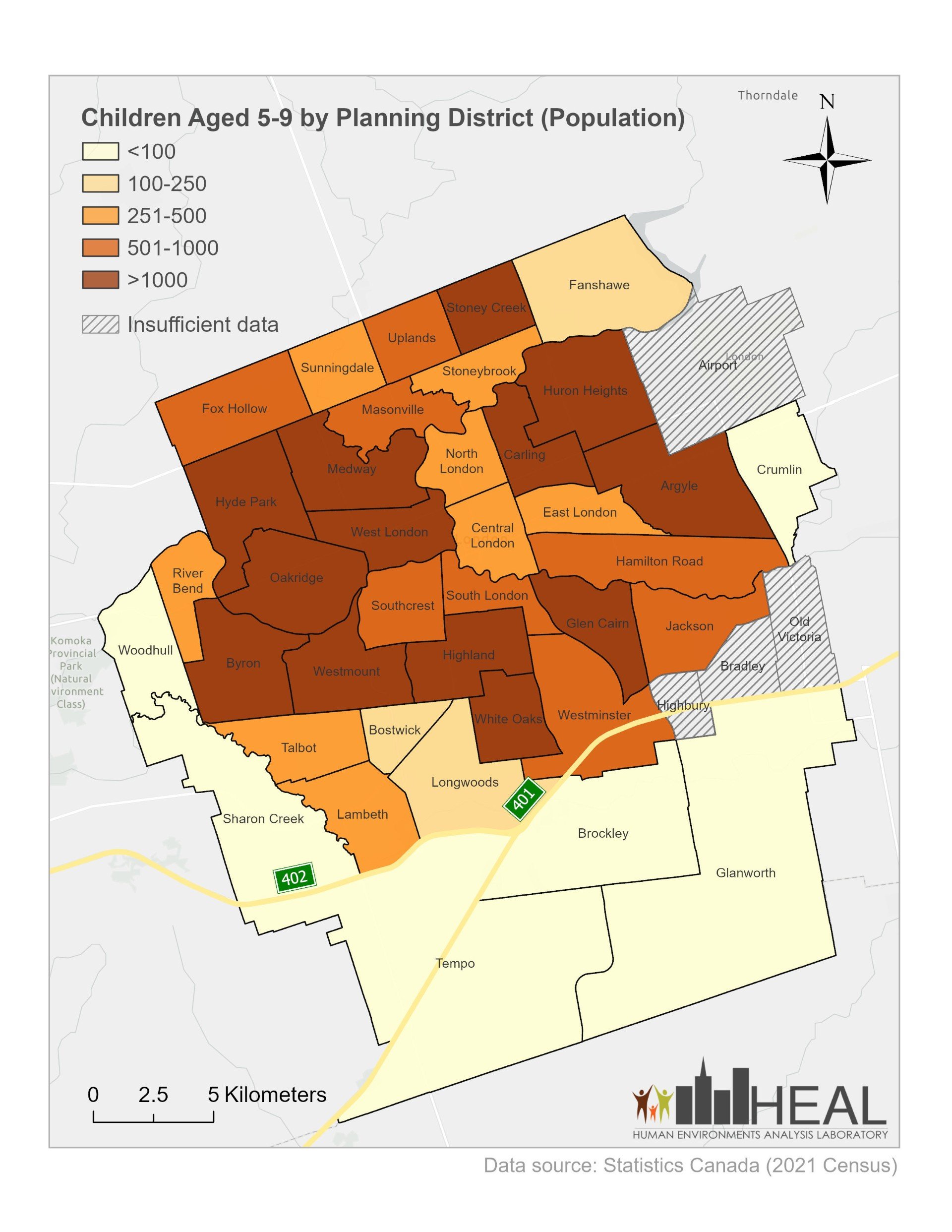
Source: Statistics Canada. Community Data Program, Table EO3775 – Ontario 3 – 2021 Target Group Profile. Map prepared by the Human Environments Analysis Laboratory of Western University.
The two maps above tell almost the same story. One counts children aged 0 to 4. The other counts children aged 5 to 9. The darkest districts, each home to more than 1,000 children, fall in roughly the same spots on both. Medway, White Oaks, Carling, Huron Heights, Highland and Argyle show up on each. West London, Oakridge, Byron, Westmount and Glen Cairn join them among the older children.
It helps to be clear about what these maps show and what they do not. They show where the most children live. They do not show where children are most common from one home to the next, because the colours count children, not rates. A bigger district holds bigger numbers, simply because more people live there. The maps also count every child in London. They do not tell us which families arrived last year and which have been here for generations.
Now add a third map.
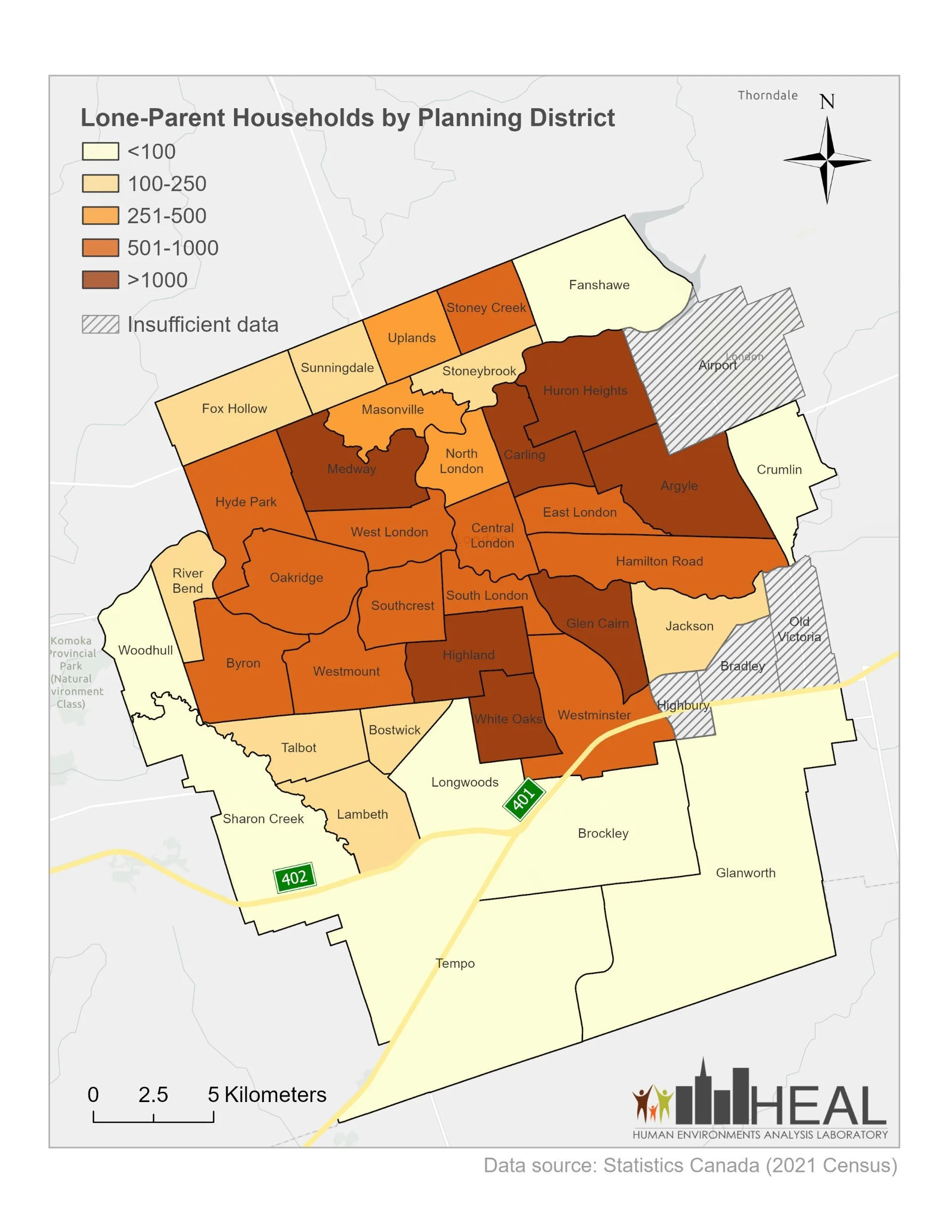
Source: Statistics Canada. Community Data Program, Table EO3775 – Ontario 3 – 2021 Target Group Profile. Map prepared by the Human Environments Analysis Laboratory of Western University.
This one counts lone-parent households, and many of the same neighbourhoods return. Medway, Highland, White Oaks, Glen Cairn, Carling, Huron Heights and Argyle each hold more than 1,000 one-parent homes. So the districts with the most young children often have the most one-parent families too.
There is a newcomer thread running through these neighbourhoods, and it is worth stating with care. An earlier Matter of Facts post found that recent immigrants in London settle most in White Oaks and North Central. Housing guides written for new arrivals point them toward the same affordable, transit-served areas: White Oaks, Argyle, Carling and Southcrest. These districts hold more rental housing and lower rents. Families put down roots where housing is within reach, and many newcomer families are putting down roots here.
The overlap matters for a practical reason. A one-parent household runs on a single income and one pair of hands for drop-off, pickup and every appointment in between. London is also one of the harder cities in Canada to find child care. A report from the Canadian Centre for Policy Alternatives found that about half of the city's young children live in areas with very few child-care spaces.
Here is the useful part for anyone who works with families. These maps point to where the children are. If you plan early-years programming, family services or settlement support, the data gives you a starting place. Families searching for child care can join the London and Middlesex waitlist, the One List, at london.onehsn.com. Newcomer families can find settlement help through the City of London's newcomer services. Services reach the most people when they sit where the families already live.
The London & Middlesex Local Immigration Partnership is funded by Immigration, Refugees and Citizenship Canada.
Source: Statistics Canada, Community Data Program, Table EO3775, Ontario 3, 2021 Target Group Profile. Maps prepared by the Human Environments Analysis Laboratory at Western University.