Who feels at home in London-Middlesex
Matter of Facts, Part 56. Prepared by the London & Middlesex Local Immigration Partnership Fact Sharing Work Group.
A new survey of newcomers in London-Middlesex looks, at first, like good news for those with the most education. Permanent residents with a graduate or professional degree report the most trust in their neighbours, the strongest sense of belonging, and the easiest time getting the services they need.
Read the chart that way and it sounds like a story about schooling paying off. Read it the other way and it shows us something we can use. The newcomers with the least formal schooling sit at the bottom of all three measures, and that is the part a welcoming community can act on.
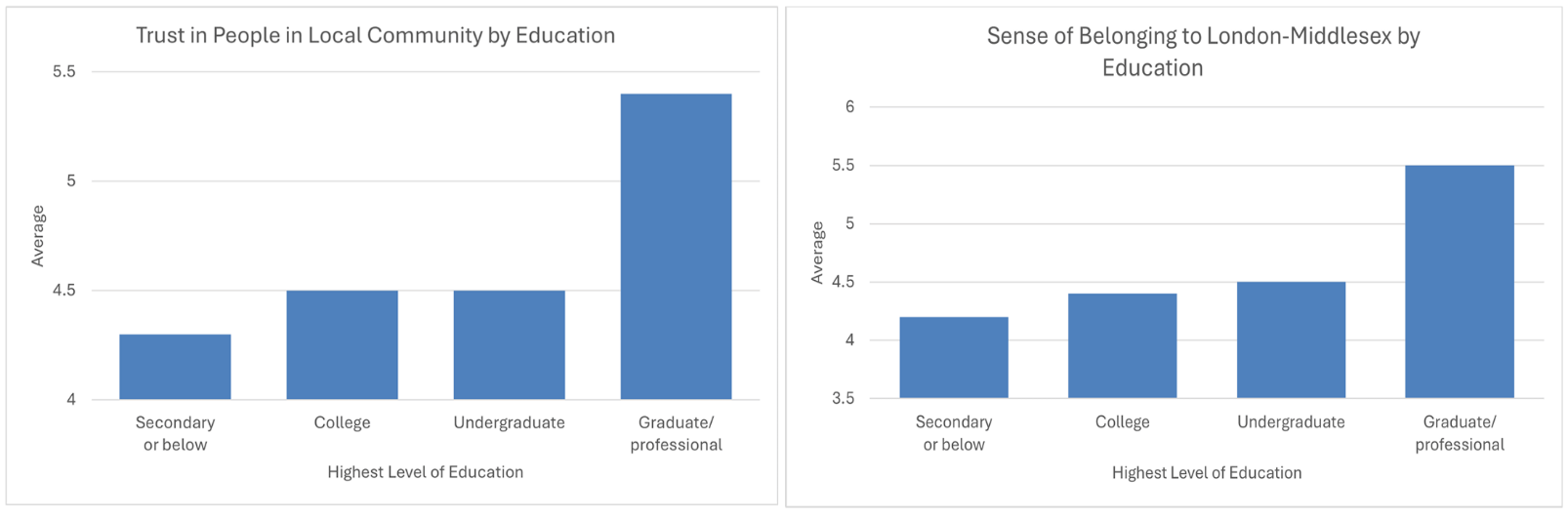
Source: Lammert, J., Oshiogbele, G., Nielsen, E., & Esses, V. (2025). Survey of newcomers to London-Middlesex (Part A): A study of the experiences, challenges, and strengths of permanent residents in London-Middlesex. City of London. Figures 25 (based on 384 responses) and 59 (based on 383 responses) are shown on the left and right, respectively.
The gaps are real, though not huge. On a seven-point scale, sense of belonging to London-Middlesex runs from about 4.2 for people with secondary school or less to 5.5 for those with a graduate degree. Ease of getting needed services runs from 3.9 to 5.2 the same way. Trust follows the same shape.
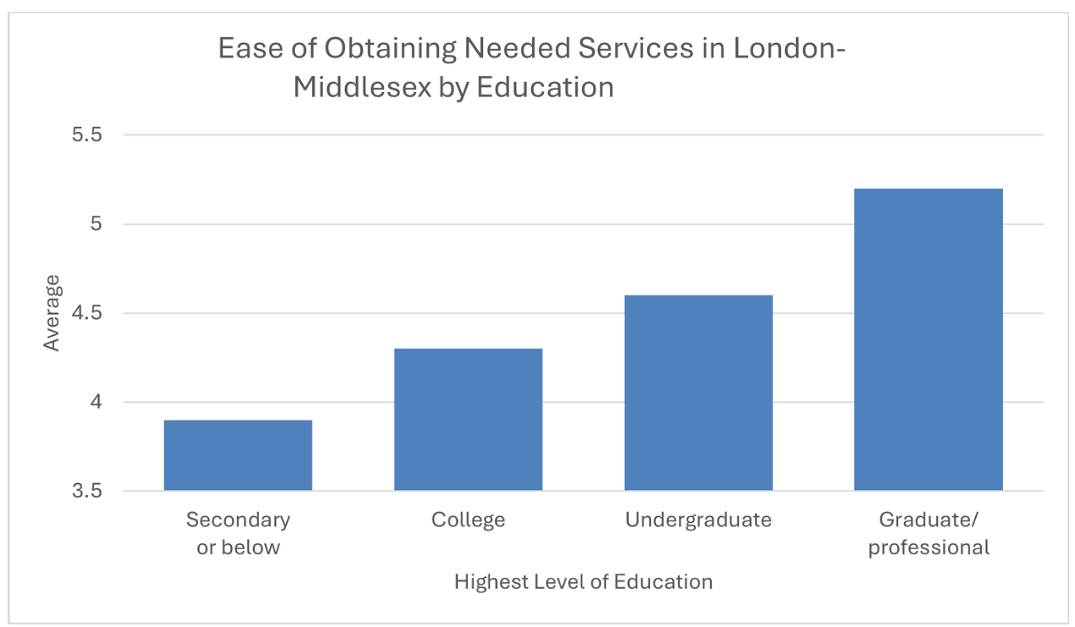
Source: Lammert, J., Oshiogbele, G., Nielsen, E., & Esses, V. (2025). Survey of newcomers to London-Middlesex (Part A): A study of the experiences, challenges, and strengths of permanent residents in London-Middlesex. City of London. [Figure 152, based on 382 responses.]
Here is the part worth sitting with. A diploma does not hand a person trust in their neighbours. So something else is travelling alongside education. The survey points to what. More than 85% of these newcomers earned their highest qualification outside Canada. Those with graduate degrees tend to arrive with stronger English, work that fits their training, higher income, and a wider circle of contacts. Those advantages, more than the diploma itself, are what help a person settle in and feel at home.
Two findings make this plain.
The first is about work. Over half of the permanent residents surveyed, 53.7%, are not doing the kind of job they held before coming to Canada. When they were asked why suitable work was hard to find, the most common answer was a lack of Canadian work experience. Newcomers with graduate degrees were the most likely to land work that fits their training. College-trained newcomers were the least likely.
The timing here matters. Ontario changed a rule in January 2026. Employers can no longer ask for Canadian work experience in a job posting or an application form. The survey named that barrier. The rule has now removed it. For local employers, that is an open door to look again at skills trained in another country.
The second finding is about help. About half of the newcomers surveyed could not fully get the service they needed most when they arrived. That was hardest for older newcomers, for those who had been here only a short time, and for those with less schooling. The common roadblocks were money, transportation, language, and plain confusion about who to ask.
What drives this gap is how findable and usable the help is. A service that is clearly signposted, offered in plain language, and simple to reach will close more of it than anything a newcomer could change on their own.
So the chart is less a ranking of newcomers and more a map of where help counts most. A welcoming community reads it from the bottom step up. For settlement and language programs, that means aiming early, easy-to-follow support at the newcomers with the least schooling and the least English. For employers, it means giving qualifications earned abroad a fair second look, now that the old barrier is gone.
Newcomers in London-Middlesex can find settlement help, language assessment, and employment support through local agencies. Help reaches the most people when it sits where the people who need it already are.
The London & Middlesex Local Immigration Partnership is funded by Immigration, Refugees and Citizenship Canada.
Source: Lammert, J., Oshiogbele, G., Nielsen, E., & Esses, V. (2025). Survey of Newcomers to London-Middlesex (Part A): A Study of the Experiences, Challenges, and Strengths of Permanent Residents in London-Middlesex. Network for Economic and Social Trends, Western University, for the City of London. Figures 25, 59 and 152.