London grew. Here's what actually drove it.
You may have seen the headlines: Canada's population actually shrank in the third quarter of 2025, the first time that had happened in decades. National news covered it. What those headlines mostly skipped was the London version of that story, and the London version is worth looking at closely.
New data from Statistics Canada, analyzed by the LMLIP's Fact Sharing Work Group as part of the Matter of Facts series, tracks how London's population changed between 2020 and 2025.
Two things stand out.
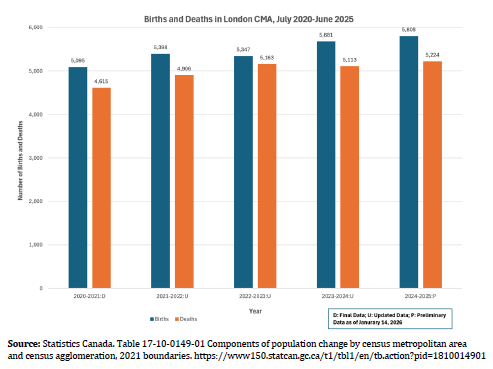
The first is what stayed stable. Births in the London Census Metropolitan Area consistently exceeded deaths across the entire five-year period. In 2024-2025, there were 5,808 births and 5,224 deaths, resulting in a natural increase of about 584 people. That gap held fairly steady throughout. London wasn't shrinking on its own.
The second is what actually drove growth. Natural increase was a small part of the picture. Migration did the heavier work, and within migration, one category did most of it.
Non-permanent residents: international students, temporary workers, and others on time-limited permits were the largest single contributor to London's population growth between 2021 and 2024. In 2022-2023 alone, they added a net 13,248 people to the city. That's roughly 22 times the natural increase from births and deaths in the same year.
Those 13,000-plus people were not abstractions. They rented apartments in Old North and Wortley Village. They took classes at Western and Fanshawe. They worked shifts in healthcare, food service, and logistics, sectors that struggled to keep up with demand in those years. Their presence wasn't a footnote to the city's growth; it was the growth.
Then the numbers reversed. Federal policies affecting temporary residents tightened through 2023 and accelerated into 2024. By 2024-2025, net non-permanent residents had fallen from the peak of +13,248 to -1,777. That's a swing of roughly 15,000 people in two years, in a city of about half a million. The change didn't announce itself loudly, but it shows up clearly in the data.
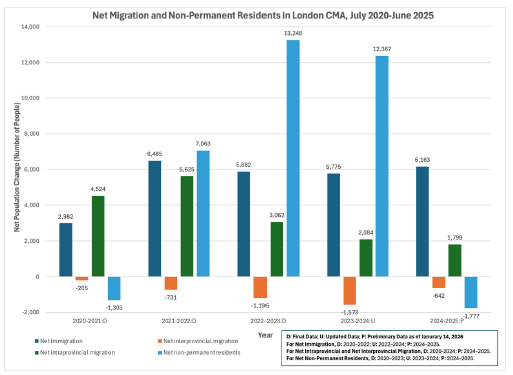
It's also worth noting that London was losing people to other provinces every single year of the study period; net interprovincial migration was negative in all five years. The GTA-to-London flow that bumped intraprovincial numbers in 2021-2022 has been declining since.
So where does that leave things? Permanent immigration remained steady throughout the period and peaked in 2024-2025, at a net of 6,163 people. The city is still receiving newcomers. What changed is the mix, which categories of people are arriving, under what conditions, and in what numbers.
For anyone making decisions about service capacity, staff planning, or community programming, that distinction matters. The growth environment of 2021-2024 was built on specific conditions that no longer fully apply. A different moment, one that planning should reflect.
The full Matter of Facts #52 fact sheet, with complete Statistics Canada data and charts, is available on the LMLIP website.
This project is funded by Immigration, Refugees and Citizenship Canada.