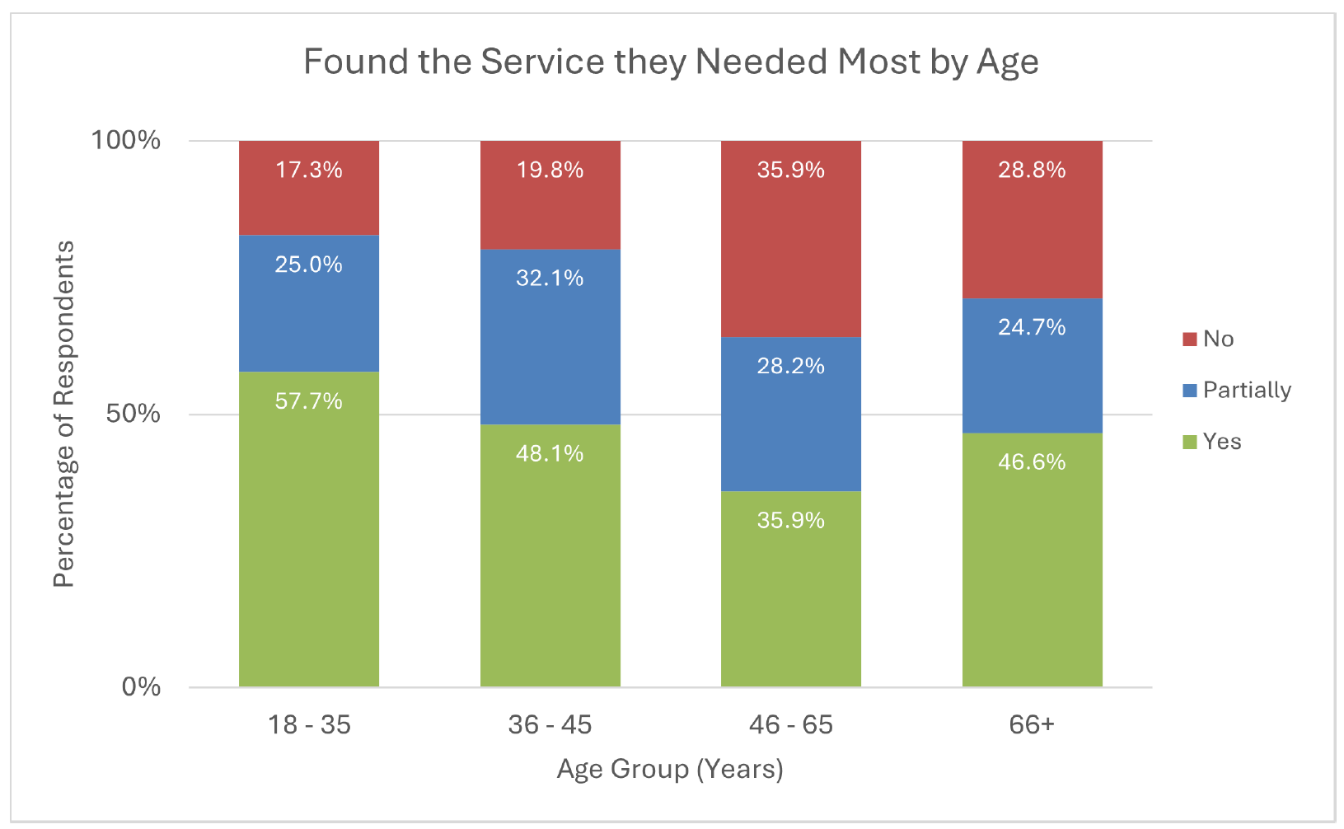
Less than half of permanent residents in London and Middlesex can access the service they need most when they arrive. But one group fares worse than all others: people aged 46–65, with only 36% reporting success. As seen in the latest Matter of Facts report from the LMLIP. These are mid-career professionals, people who should have resources, experience, and networks. So why are they falling through the cracks?
Source: Lammert, J., Oshiogbele, G., Nielsen, E., & Esses, V. (2025). Survey of newcomers to London-Middlesex (Part A): A study of the experiences, challenges, and strengths of permanent residents in London-Middlesex. City of London. [Figure 158, based on 361 responses.]
The Data Paints a Surprising Picture
A survey of 387 permanent residents in London and Middlesex reveals a service access gap that defies expectations. Young adults aged 18–35 were most likely to find what they needed, with 58% reporting success and only 17% unable to access services. Even seniors aged 66 and over did better than the middle group, with 47% finding the needed service.
But adults aged 46–65 faced the steepest barriers: only 36% could access what they needed, while an equal proportion, 36%, reported complete inability to do so.
The top service people needed was employment support, chosen by 34.2% of respondents overall. For the 46–65 age group specifically, that number jumped to 44.7%. These are people arriving with professional experience and credentials, expecting to continue their careers. Instead, they hit walls.
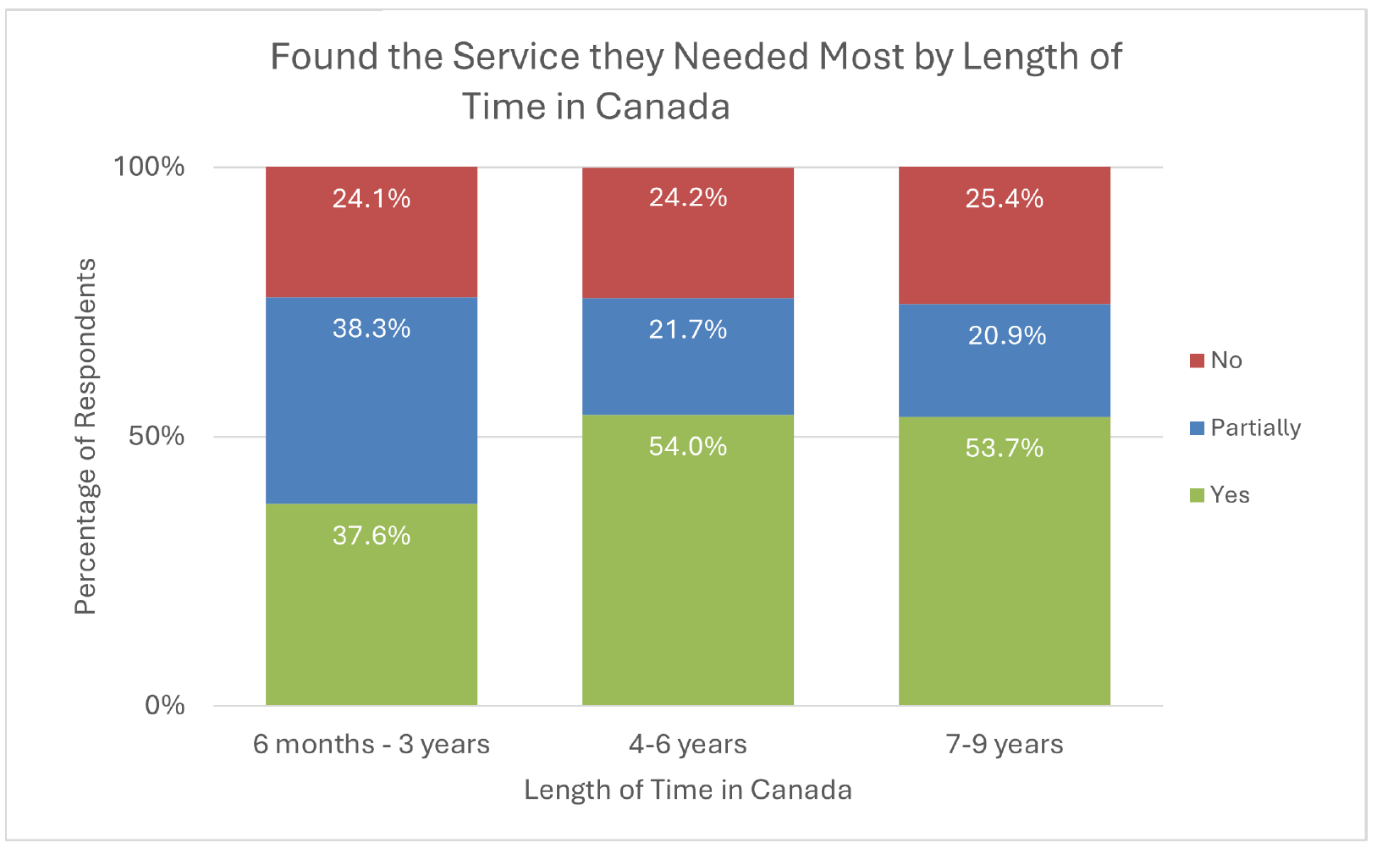
Time in Canada helps, but it doesn't solve everything. Recent arrivals (6 months to 3 years) had the lowest success rate at 38%. Those who had been here longer did better, 54% success for people here 4–6 years and 54% for those here 7–9 years. Yet across all three groups, roughly one-quarter of respondents still couldn't access needed services even after years in the region.
Source: Lammert, J., Oshiogbele, G., Nielsen, E., & Esses, V. (2025). Survey of newcomers to London-Middlesex (Part A): A study of the experiences, challenges, and strengths of permanent residents in London-Middlesex. City of London. [Figure 159, based on 361 responses.]
Why the Middle Gets Lost
Several patterns in newcomer research and broader Canadian evidence point to why the "should be fine" group is actually struggling.
Credential recognition becomes a career trap. Mid-career professionals often come from regulated fields where foreign credential recognition is slow, expensive, and riskier this late in life. They're "too experienced" for entry-level roles and "not Canadian enough" for senior positions. The London-Middlesex survey confirms immigrants are highly educated yet over-qualified and under-employed; a pattern especially acute for mid-career professionals whose foreign degrees carry less weight in the local labour market.
Requirements for Canadian experience and licensing exams delay or block access to work that matches their skills. This produces a disconnect: standard employment services can help someone write a resume, but they can't solve the systemic barriers keeping qualified professionals out of their fields.
Digital navigation creates unexpected gaps. Research on digital equity shows that vulnerable adults with limited digital skills struggle with online forms, portals, and appointment systems. Newcomers with high formal education but less experience with Canadian e-government platforms fall into this gap. Ontario-wide studies note that those with language barriers are less likely to access services digitally, even when they exist—a pattern that maps onto mid-career clients who didn't grow up in a fully digital service environment.
Self-reliance norms delay help-seeking. Needs assessments in Ontario newcomer communities show that many middle-aged newcomers report either "not needing services" or "not knowing about services but not planning to use them,” despite simultaneously reporting difficulty accessing information and navigating systems. They rely on family, informal networks, or their own problem-solving first. They only approach formal services when problems have escalated, by which time generic workshops feel misaligned with their complex situations.
Time poverty collides with service design. Local data shows that most services are community connections and education programs offered during standard hours, with relatively little targeted case management for mid-career professionals juggling survival jobs, licensing requirements, and family responsibilities. National studies consistently show that those working multiple jobs while caring for children or elders struggle to attend daytime workshops or multi-session programs. This creates a pattern of partial or failed service use.
Family pressures multiply complexity. For 46–65 newcomers, arrival often coincides with supporting teenage or young adult children and sometimes older parents abroad or in Canada. Needs assessments note a strong demand for translation, school-system navigation, and advocacy support, indicating parents are often the primary administrators of household paperwork. They approach services with complex, multi-person issues that the typical "individual newcomer" service model doesn't anticipate.
Discrimination compounds at multiple points. The London-Middlesex survey and media coverage underscore that discrimination and underemployment are common among newcomers. Older age further amplifies employer bias about "fit," trainability, and return on investment. National evidence on foreign credential recognition shows systemic racism, with reliance on "country of education" as a proxy for quality; particularly harming seasoned professionals from the Global South trying to enter mid- to senior-level roles.
What This Means for Service Design
The 46–65 group presents with complex, multi-system problems that single-service interventions cannot resolve. Even when they locate services, they don't experience them as meeting their needs because the barriers they face, licensing, employer bias, and digital systems, are structural, not informational.
The persistent 25% who report not finding needed services across all time periods suggests this isn't just an adjustment issue. Barriers include cost (34.9% of permanent residents cite this), transportation (33.0%), confusion about whom to contact (24.6%), and language (24.0%). Those outside London face service-hours barriers and a lack of services, while those in the city more often report confusion about navigation.
Service systems may need to shift from assuming "professional = self-sufficient" to recognizing that mid-career newcomers face distinct, compounding barriers. This could mean:
Navigation support that recognizes credential recognition as a barrier, not just an information gap
Service hours and delivery methods that work for people juggling multiple jobs and family responsibilities
Case management that addresses multi-system problems rather than single-service solutions
Digital supports that meet people where they are, not where we assume they should be
The invisible middle remains invisible until we design systems that see them.
This analysis draws on a survey of 387 permanent residents in London and Middlesex conducted by Network for Economic and Social Trends (NEST), the City of London, and the London & Middlesex Local Immigration Partnership. For the full report, visit london.ca. For the Fact sheet breaking down the subject of this article, read Matter of Facts #49.