Same front door, different odds: who really struggles to find a doctor in Middlesex-London
Matter of Facts Series, Part 57 | London & Middlesex Local Immigration Partnership (LMLIP) Fact Sharing Work Group
Did you know? You might guess that visible minorities in Middlesex-London have the hardest time finding a regular doctor. The data says something more specific and more useful than that.
Right now, finding a family doctor in Middlesex-London is hard for almost everyone. About 93,000 people in the London area do not have one. Across Ontario, 1 in 4 people is expected to be without a family doctor by the end of 2026. The shortage is already serious.
New local data helps answer a sharper question: when a shared system is this strained, who gets left out first?
The part that looks the same for everyone
New data from the 2022 Canadian Community Health Survey, for the Middlesex-London area, shows something that might surprise you. Immigrants and non-immigrants use family doctors at almost the same rate.
80.8% of non-immigrants have a family doctor or general practitioner as their regular healthcare provider.
80.1% of immigrants or non-permanent residents have one too.
Less than one point of difference. Read only this far and you might conclude immigration status barely matters for healthcare access here. That conclusion would be wrong. The real gap is hiding one level down.
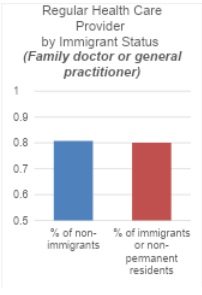
Immigrants and non-immigrants in Middlesex-London use family doctors at almost the same rate, around 8 in 10 for both groups.
The part that doesn't
Family doctors aren't the only regular provider people use. Some see a nurse practitioner. Some see a medical specialist regularly. And some have no regular provider at all: no one to call when they get sick, no one who knows their history.
This is where the gap opens up:
8.3% of non-immigrants have no regular healthcare provider.
13.5% of immigrants or non-permanent residents have no regular healthcare provider, about 1 in 7.
Immigrants and non-permanent residents are also less likely to use a nurse practitioner, medical specialist, or other regular provider as a backup. This group isn't finding a different way into the system. Many simply aren't getting in.
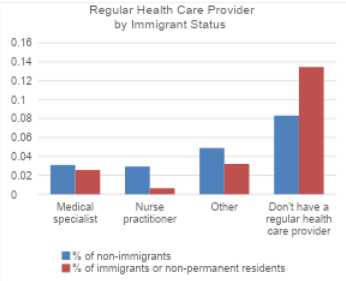
Immigrants and non-permanent residents are less likely to use any regular provider, and more likely to have none at all.
The part that surprised us
Here's where the local data does something most national studies skip: it looks at immigration status and visible minority status together, not separately.
The result caught our attention. Non-immigrants who are visible minorities have the best access to a family doctor of any group in the local sample: 92.6%. That beats non-immigrants who are not visible minorities (80.2%) by a wide margin.
So visible minority status, by itself, doesn't predict worse access to a family doctor in this data. Something else is driving the gap, and it only shows up once you cross the two factors.
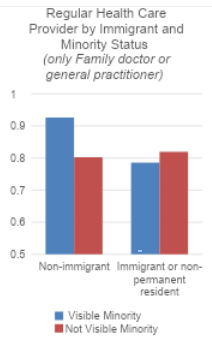
Non-immigrant visible minorities have the highest rate of family doctor access of any group measured, 92.6%.
Where the real gap shows up
The real gap appears only when both things are true at once: someone is an immigrant or non-permanent resident, and a visible minority.
Among immigrants or non-permanent residents who are visible minorities, 17.9% have no regular healthcare provider at all.
That's more than double the rate for non-immigrants (8.3%).
It's also more than double the rate for immigrants or non-permanent residents who are not visible minorities (8.3%).
Neither immigration status nor visible minority status alone explains this. The overlap does. That overlap, immigrant or non-permanent resident and visible minority, is the single biggest predictor of going without a regular healthcare provider in Middlesex-London.
Why this happens
Research from across Canada points to a few recurring reasons newcomers, and newcomer visible minorities especially, struggle to connect with a regular provider. Not knowing how the system works is one of the biggest: Canada's healthcare system is genuinely confusing to navigate without help from family, friends, or community connections who've already been through it. Language is another; booking appointments, describing symptoms, and understanding instructions all get harder in a second language. Time in Canada matters too. Newer immigrants are less likely to have a family doctor than immigrants who've lived here longer, which suggests access improves as people build local support and familiarity. And cost still gets in the way for some: visible minority immigrants report running into cost-related barriers to care more often than long-settled, non-visible-minority residents.
None of this points to the system deliberately excluding anyone. A system already stretched thin just doesn't distribute its strain evenly. Without deliberate outreach, the people with the least existing support are the ones most likely to fall through.
What's being done, and what you can do
The Middlesex-London Ontario Health Team recently received $10.8 million in new provincial funding to connect more than 23,000 residents to team-based primary care. That's a real chance to close this specific gap, but only if newcomers, and newcomer visible minorities in particular, get actively reached and supported through it rather than folded into a general list.
If you don't have a regular healthcare provider, here's what you can do right now:
Register with Health Care Connect at ontario.ca/healthcareconnect, or by phone. It's free and takes a few minutes; you'll need your OHIP card. You'll be matched with a Care Connector who works to link you with a family doctor or nurse practitioner.
Ask a settlement agency for help. Organizations such as the London Cross-Cultural Learner Centre and the South London Neighbourhood Resource Centre can help you navigate the healthcare system in your own language, alongside other settlement support.
Consider a community health centre. London InterCommunity Health Centre and similar centres are built for people who face extra barriers to care.
Everyone in Middlesex-London is walking up to the same front door: a healthcare system with too few family doctors for too many people. This data shows that not everyone gets through that door at the same rate. Knowing exactly who's being left behind is the first step to closing the gap.
A note on this data: These findings come from a custom cross-tabulation of the 2022 Canadian Community Health Survey (CCHS), Public Use Microdata File, for the Middlesex-London Health Unit area (n=769, non-responders excluded). The sample is modest, especially once split by both immigration and visible minority status, so read these numbers as a reliable local signal, not a precise national measurement.
Source: Statistics Canada. Canadian Community Health Survey (CCHS), 2022. Custom cross-tabulation accessed through Public Use Microdata File (PUMF); based on Middlesex-London HU geographical area, non-responders excluded.