Routes to Opportunity
What transportation data reveals about immigrants, newcomers, and access to work in London
At first glance, the story seems clear: most workers in London commute locally, and most rely on cars. But when we look more closely, the data tells a deeper story about settlement, affordability, work schedules, and opportunity.
This blog is based on LMLIP’s Matter of Facts #54, which highlights transportation patterns among London’s employed labour force and helps connect commuting data to settlement, employment, and inclusion.
A Commute Is More Than a Trip
Who gets to work with ease? Who depends on a car? Who spends more time commuting? And who is leaving home for work when most of the city is still asleep?
Transportation may look like a simple daily routine, but for many people it is one of the biggest factors shaping access to employment. New data from the 2021 Census gives us a closer look at how London’s employed labour force moves to work, and how those patterns differ between non-immigrants, immigrants, recent immigrants, and non-permanent residents.
For many immigrants and newcomers, the commute is not just a trip to work. It is part of the larger journey of building stability in a new city.
Most Workers Commute Locally But Newer Groups Travel Farther
Most workers in London CMA commute within their local area. Across most groups, about 80% to 90% of workers stay within their census subdivision, meaning they work in the same municipality where they live.
That suggests many people are able to find work relatively close to home. But not everyone experiences the city in the same way.
Recent immigrants who arrived between 2016 and 2021, as well as non-permanent residents, are more likely to travel outside their local area for work. Longer-distance commuting is slightly higher among recent immigrants, at about 18%, and among non-permanent residents, at about 16%.
This matters because a longer commute can affect much more than travel time. It can affect family routines, childcare, energy levels, job choices, and the ability to participate in community life after work.
London Is Still a Car Dependent City
One of the clearest messages in the data is that London’s workforce still moves mainly by car.
Most workers commute by car, truck, or van as drivers. Around 78% of non-immigrants and 81% of immigrants drive to work. This shows how important car access remains in London’s labour market.
For many workers, driving is not simply a preference. It may be the most practical way to get to work on time, especially when job sites are outside central areas, shifts begin early or end late, or transit routes do not connect directly to workplaces.
This is where transportation becomes an employment issue. A job may be available, but if a person cannot reach it reliably, that opportunity becomes harder to accept or keep.
Recent Immigrants Face a Different Transportation Reality
The data shows that recent immigrants are using a more mixed transportation pattern than earlier immigrant groups.
Recent immigrants who arrived between 2016 and 2021 are somewhat less likely to drive and more likely to use public transit or commute as passengers. This may reflect the early stages of settlement. Many newcomers need time to obtain a Canadian driver’s licence, understand local driving rules, save for a vehicle, or move closer to employment.
This is especially important because the process of obtaining a driver’s licence can take time. For newcomers who arrive ready to work, transportation can still slow down their ability to access the right job.
Even when someone has the skills, motivation, and experience, transportation can become the barrier between employment and underemployment.
Non Permanent Residents Rely More on Transit
The most striking difference appears among non-permanent residents.
Only about 49% of non-permanent residents commute as drivers, compared with much higher rates among non-immigrants and immigrants overall. At the same time, non-permanent residents are much more likely to use public transit, at about 29%.
This tells us something important about access.
Non-permanent residents may include international students, temporary workers, and others with temporary status. Many may be renting, sharing housing, studying, working part-time, or working shift-based jobs. For this group, public transit is not just a convenience. It may be the main connection to work, school, services, and community life.
When transit service is limited in certain areas, expensive, or not aligned with early-morning, evening, or overnight work hours, the impact can be significant.
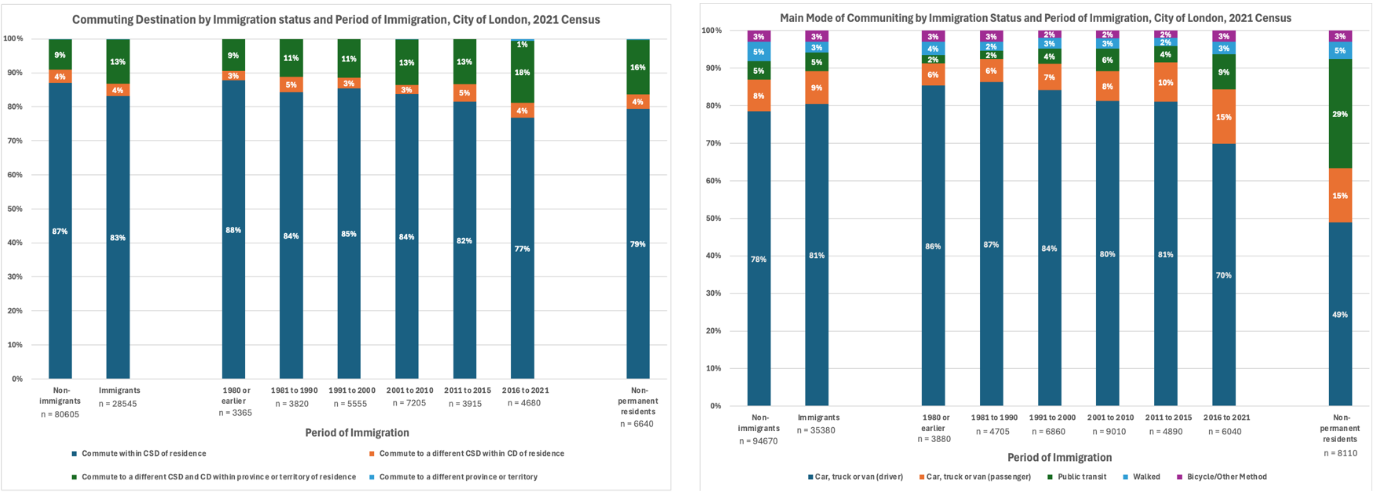
Source: Statistics Canada. Community Data Program, 2021 Target Group Profile cross-tabulated with Immigration Status by Period of Immigration and Citizenship.
Note: CSD (Census Subdivision) refers to municipalities (e.g., cities, towns). CD (Census Division) refers to larger regional groupings (e.g., counties).
Longer Commutes Take More Than Time
Most commutes in London fall between 15 and 29 minutes. But Matter of Facts #54 shows that some groups are more likely to experience longer commutes of 45 minutes or more: 7% of established immigrants who arrived in 1980 or earlier, 13% of recent immigrants who arrived between 2016 and 2021, and 18% of non-permanent residents.
This is not just a transportation statistic. It is a quality-of-life issue.
A longer commute can mean waking up earlier, arriving home later, spending more money, and having less time for family, rest, language classes, appointments, or community activities.
For immigrants and newcomers who are already balancing settlement needs, every extra minute matters. A 15-minute commute and a 60-minute commute create very different daily lives.
Work Does Not Always Start at 9 a.m.
Another important part of the data is the time workers leave for work.
Across most groups, the most common departure time is between 7:00 a.m. and 8:59 a.m. This reflects the traditional workday many people imagine when they think about commuting.
But the data also shows that many workers, especially non-permanent residents and recent immigrants, leave outside standard working hours.
Non-permanent residents are more likely to leave between 12 p.m. and 4:59 a.m., with about 33% departing during that time. Recent immigrants also show a higher share leaving during these hours, at about 26%.
This may reflect work in sectors such as hospitality, manufacturing, logistics, warehousing, caregiving, cleaning, food services, or other shift-based roles.
That matters because transportation systems are often strongest during standard work hours. But many newcomer workers may need transportation when service may be less frequent, less direct, or harder to access.
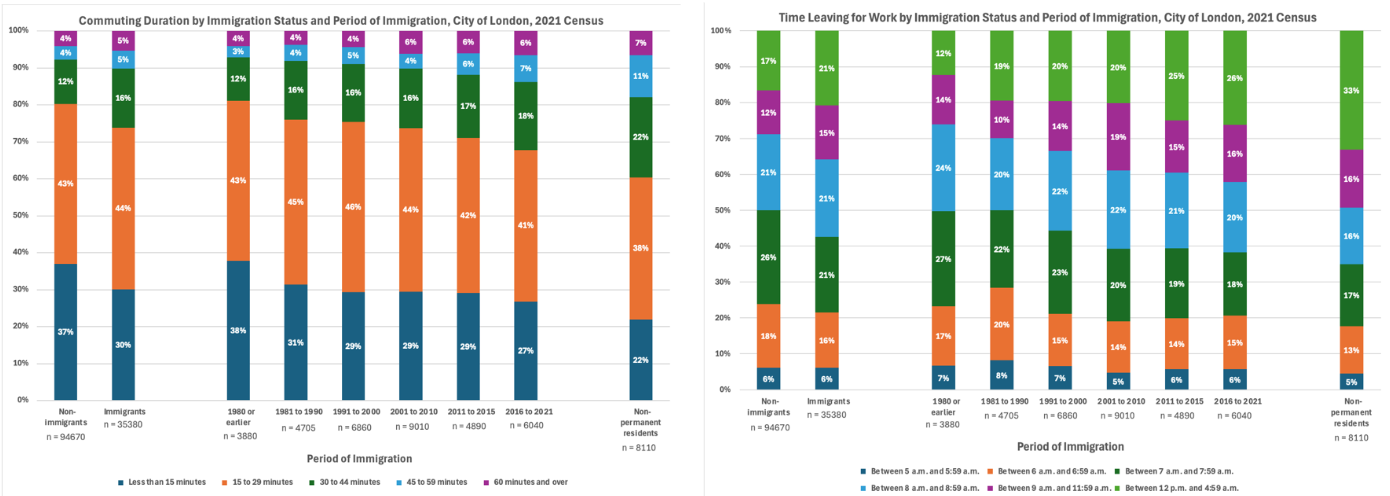
Source: Statistics Canada. Community Data Program, 2021 Target Group Profile cross-tabulated with Immigration Status by Period of Immigration and Citizenship
Transportation Is a Settlement Issue
When we talk about settlement, we often talk about language, employment, housing, childcare, and social connection. Transportation belongs in that conversation too.
Transportation affects whether someone can attend an interview.
It affects whether someone can accept a job offer.
It affects whether someone can arrive on time and stay employed.
It affects whether someone can participate in community life after work.
For immigrants and newcomers, transportation challenges may include limited transit connections in some areas or at some times of day, the long process of obtaining a driver’s licence, and not having enough income to purchase or maintain a car.
These are not small barriers. They can shape the kind of jobs people can access and the distance they can realistically travel.
Why Employers Should Care
Transportation is not only a personal issue for workers. It also affects employers.
If employees struggle to get to work, employers may experience challenges with recruitment, retention, punctuality, scheduling, and workplace stability.
Understanding transportation barriers can help employers think differently about job design and employee support. This could include considering shift times, transit access, workplace location, carpooling options, flexible scheduling, or partnerships with community organizations.
For employers trying to attract and retain immigrant talent, transportation should be part of the conversation.
Why London Should Pay Attention
The data shows that London’s transportation reality is not experienced equally.
Some workers have cars and short commutes. Others rely on public transit, travel longer distances, or leave for work outside the hours when transportation options are strongest.
For a growing and diverse city, this matters.
Transportation connects people to jobs, education, healthcare, services, and belonging. If transportation is difficult, everything else becomes harder.
For London to fully benefit from the skills, energy, and contributions of immigrants and newcomers, mobility must be seen as part of inclusion.
More Than a Commute
What this data really reveals is that commuting is not just about movement. It is about access.
It is the recent immigrant waiting to complete the driver’s licence process. It is the international student taking the bus to a late shift. It is the temporary worker leaving before sunrise. It is the parent trying to balance work, childcare, and transit schedules. It is the newcomer who has the experience for a job but not yet the transportation to reach it.
London is not only shaped by who lives here. It is shaped by how people move through it.
And if we want a city where immigrants, newcomers, non-permanent residents, and Canadian-born workers can all contribute fully, then transportation must be understood as more than infrastructure.
It is part of employment. It is part of settlement. It is part of inclusion. And it is part of belonging.